Wednesday, August 31, 2005

The Africa Center and going on Safari at the Hluhluwe Game Reserve


What wonderful memories!

As you can see from the posts and pictures, we have wonderful memories from our visit to South Africa.

My memories include: worrying as to whether everyone would get to Logan Airport in time for the 6:10 AM flight(we did!); doing my "night nurse" routine and checking on members of the group during the flights (they were fine and I got my exercise to prevent DVT's); seeing Costa at the airport to greet us; going to dinner our first evening at Jenny and Costa's home to bid old friends and colleagues Kathy and Dotty farewell; seeing friends and colleagues at Highway Hospice,the Nursing School at UKZN, McCord Hospital, Church of Scotland Hospital where we also visited an orphanage and went on home visits, St. Mary's Hospital, Lamontville Township feeding program, Africa Center, Crompton Hospital,Inkosi Albert Luthuli Hospital, and the Doris Duke Research Center at the Nelson Mandela Medical School(UKZN)and much more.

People always make the difference in every trip. There are so many people who made our trip memorable and we're grateful to all of them. Many have been special friends for a number of years. Although I won't mention names I will make one exception with Costa and Jenny who were incredible hosts. They did far more than rent us rooms. Their thoughtfulness made for a wonderful trip for the group.

Culturally, we visited a flea/craft market, saw Durban and environs, had a picnic breakfast at Tala Private Game Reserve, attended the African Footprints production, had a weekend at the beach, saw the uShaka aquarium, St.Lucia Wetlands,and Hluhluwe Game Park among other activities.

A special treat for us was the presence of the President of the MGH Institute of Health Professions for the first few days of our stay. She came to be with us and to express her support of the international activities of the Institute. We were all sorry to see her leave.

We squeezed a lot of activities into a very brief period of time. It was special for me not only because of our South African colleagues, but also because of the composition of our group. They came on this very first educational venture abroad for us as an educational institution when not all of the details had been worked out because they were committed to learning more about international health care. They came and we were all conquered with the commitment to return.

My gratitude to all who helped make this possible- who supported us in large and small ways both in South Africa and in the U.S. Thank you also to those who have decided to support the work of our South African colleagues. Inge

Sinikithemba Clinic, Church of Scotland Hospital, and a meeting with friends from Lamontville


Tuesday, August 23, 2005

Nation of contrasts

People love 80's music in South Africa; one can hear it all over: it's playing in the airport upon arrival to the country, in the public bathrooms, shopping areas, from homes. This begged the question: what does South Africa have about this music?

In retrospect, South Africa seems to be a nation of contrasts, the most striking being the division and distribution of wealth. Huge mansions with walls around their borders and caged doors sit next to (and sometimes even a block away from) miles and miles of "informal settlements," which is a very "nice" description for the millions of homes that have been build by the people (illegally) that grip to hillsides and areas just outside of major urban areas. The informal settlements do not have government-supplied sanitation or electricity, and people use plastic trash bags as roof-tops. It is rumored that the government has begun a housing project, where a sturdy home of wood or brick will be built for every family in a settlement; however, according to a South African I met, "it will take over 100 year at the rate they're going." I am not sure of the proportions of people living in informal settlements to those living in mansions, but I would suspect that it mirrors the ratio of those with health care to those with none: 5:1.

Another contrast: in the few settlements I observed and in other communities throughout the country, people were pulling together. South Africans are very proud of where they live, and they identify with and want to help others around them. Florence, a "retired" nurse and dear friend of Inge, works day and night for her community; she runs a soup kitchen that feeds hundrend of the sick and injured daily, and she is building a health center for AIDS and hospice patients. People love her, they trust her, people want her near them as a leader. Then, we have the counterpoint: crime rates are extremely high in South Africa. Theft and rape are major problems, and they are crimes diametrically opposed to the neighborhood trust I just described. It seems to me that the crime in South Africa is directly related to poverty and to the lingering sting of apartheid. Despite these problems, I never once felt threatened or scared, and if I did, I believe that a mere "yelp" would have garnered the help of many.

The next conrast has to do with racial tensions in the aftermath of aparthied, which ended only 11 years ago. I think that South Africa has come a long way, especially in terms of equality in politics and law (at least on the surface). In the cities especially, the populations seem to be more diverse and integrated than in smaller, more rural towns. That's not to say that the urban areas are completely intergrated: they aren't, but neither is Chicago, New York, LA, etc. However, there still exists extreme racsim along with major differences in income, academic and employment opportunities, and access to resources, like healthcare, between races and gender. Hopefully with time these discrepencies will diminish, as they are slowly doing in our country. Just talking to people elicited different responses about the situation in South Africa since Apartheid; several people I spoke with think that they have come a long way but still have a long way to come. On a good note, at the various healthcare settings we visited, from small clinics to large hospitals, the workers and patients - of many races - worked together and were treated side-by-side as equals.

Sub-sarahan Africa in general and South Africa in specific have been struck by the HIV and AIDS epidemic. Admist the pain, sorrow and difficulties that surround the impact of HIV, hope, altruism and love are clearly evident and seem to outweigh the hardships. And that gives me hope. I think that is why people love the 80s music in South Africa: to me it is a music (corny at times, yes) filled with compassion (remember "We are the world?") and messages of community, love, and hope for a better future.

Courtney

Wednesday, August 17, 2005

Reflections on South Africa

Dear friends and readers,

I returned from South Africa approximately three days ago and I am just beginning to recover from the jet lag (although I do enjoy waking up and feeling awake at 5am). In any case, I will try to summarize my overall impressions of my experience in South Africa.

One of my first impressions of the country and the one that has remained with me throughout my travels was the incredible vibe that I felt there. There was a political vibe, a cultural vibe, and a spiritual vibe. Politically, the country continues to recover from the apartheid years and the effects of apartheid are still very prevalent; particularly the existence of townships. Culturally, the country is so incredibly diverse that it pulses with diversity and multiculturalism. South Africa has the largest Indian population outside of India and eleven national languages! Spiritually, South Africa is vibrant. We saw this spirit displayed in several ways, from protests to prayer ceremonies. On two separate occasions we witnessed protesters doing the characteristic toyi-toyi dance to demonstrate their cause. One protest was among workers at the local "Pick and Pay" supermarket. The other protest was in a rural area called Tugela Ferry. Protesters there were holding signs that read, "Away with Sex"; most likely because the rural areas have such high rates of HIV infection. Song and dance is used often in South Africa during prayer and other ceremonial acts and is very very effective.

A major focus of our international health experience was the issue of HIV/AIDS. We began to understand why HIV and AIDS are so rampant in South Africa and what is being done (or not being done) to curb the devastating effects of the disease. South Africa is more developed than most other African nations, yet the problem of HIV in South Africa is the worst. I can only explain this by considering that as a developed nation, South Africa has easier and faster modes of transportation. Men, in particular, will leave their homes to work in mines or other faraway destinations. People are undereducated and traditional belief systems are prevalent. Women are marginalized to a considerable degree and many men have multiple sexual partners. Condoms are not widely used. The idea of testing for HIV is nonexistent for many people because of the incredible stigma of being infected. The rollout of antiretroviral medications is extremely slow and only began last year. Traditional remedies of olive oil, potato, leeks, and garlic are still endorsed by the minister of health. Only those who can afford to pay the monthly fee for medications are priveleged enough to have it in most places. Programs implementing ARVs have strict protocols for teaching adherence and only those who will be adherent will qualify for medications.

Tuberculosis is a common comorbidity of HIV/AIDS and more people will die from TB than HIV. People are typically treated for at least two weeks on TB medications before initiating antiretroviral medications. This is done to prevent an immune reconstitution syndrome whereby the latent TB bacteria surge do to a sudden resurgence of the immune system from the ARVs. This can actually kill people relatively fast so prevention with TB medication is necessary.

I am glad to have had the chance to visit such a phenomenal country and to have met so many outstanding people. People who work so hard despite the odds against them. It was an inspiring trip that truly changed my life. Thank you to Inge and everyone else at the IHP for making it happen. Thank you to Costas and Jenny for taking such good care of us while we were there. The group could not have been any better and it was a pleasure having Ann with us in the beginning.

Thank you again and Cheers, Lisa

Thursday, August 11, 2005

The African Centre

Friday. July 29th: The last Friday of our trip we drove to the region of Hluhluwe (shoosh-louie) located North of Durban. Our first stop was to the African Centre near the town of Mtubatuba. The Centre is a joint project of the University of KwaZulu-Natal and the Medical Research Council of South Africa. The centre receives financial support from the Presidents Emergency Plan for AIDS relief (PEPFAR).

The African Centre is dedicated to HIV-AIDS research studies, and to the delivery of health to the KwaZulu Natal region. It is located in a brand-new, state of the art facility near the town of Mtubatuba and provides help to the community at different levels including: community-based HIV surveillance, support to the Hlabisa Hospital, and several on-going prevention trials. Some of the research programs include: Microbicidals development program, Population based counseling and testing, and Adherence to HIV treatment vs. depression. The centre has also developed a very comprehensive data system of the area.

The centre takes pride in its environmental friendly approach of management, and to being a source of employment to the town of Mtubatuba. The town of Mtubatuba has a population of 90,000 people. It also has one of the highest rate of HIV-AIDS in S. Africa.

There is a lot more of information about the centre but in the interest of time I should finish here. However, if you want more information abut the center, and about their research studies you can visit their website at www.africacentre.org.za

Enjoy,
Carmen

Monday, August 08, 2005


It was hard to say goodbye to Sr. Regina and St. Mary's Hospital.

St. Mary's Hospital, July 27, 2005

Hello Blog readers!
Well, it has been almost a week since our return and we still have so much to share from our International Health Experience :)
The last Wednesday we were in Durban, we spent the morning with Sr. Regina at St. Mary's Hospital just outside of Durban. St. Mary's is a 200 bed community hospital which services the Inner/Outer Ethekwini Community (750,000 people!).
One program at St. Mary's is the Ithemba ARV Program which is funded by PEPFAR. The clinic was founded in 2003 as a collaboration between St. Mary's, Harvard University Partners AIDS Research Center and Pangea San Francisco AIDS Foundation.
The Mission of this clinic:

"To give life and improve quality of living to the community we serve by delivering holistic care to patients and families with HIV/AIDS by returning hope and delivering ARV's"

Quite a powerful mission...and Sr. Regina is a phenomenal Nurse! She walked us around the different units of the hospital as well as the outpatient antenatal clinic (I think we all liked this one a lot because of the cute babies there with their mothers for check-ups etc.). Everyone we met was not only welcoming and willing to talk more about what they do, but also quite motivated to work hard because they are making such a difference in the lives of their patients.

It was exciting to talk to one of the research assistants who explained one research study being done to test out ARV's on AIDS-infected infants...the thought is that since the babys' immune systems are immature, perhaps the use of ARV's initially followed by periods of no ARV's may allow the infant's developing immune system to begin to fight off the virus. It is quite hopeful that some of this research may lead to less infants dying from AIDS.

Spending time at St. Mary's, with Sr. Regina, was truly inspiring...to see all the good work being done in the fight against AIDS was hopeful...

Tuesday, July 26, 2005

Lamontville on July 26th


Our new friends at the Lamontville Community Soup Kitchen.......they are doing such good work!


Florence (in the front) is truly amazing. She started a soup kitchen only two months ago and it is a huge success. The way she runs the organization seems like she's been at it for years. The volunteers love her! She is feeding about 250 people a day...but this is not enough in a community of roughly 80,000 people. If you want to support her work you can donate to an organization called Sibusiso. Sibusiso is a local organization....(in Boston that is!) that raises money for projects on the ground in South Africa. Florence's soup kitchen is one of them. Go to www.sibusisopartners.org or call 617-731-7751 for more information.

Tala Private Game Reserve on July 17th


Springbok antelope grazing by the lake......


We saw giraffes! Don't worry they were very very friendly....

Sunday, July 24, 2005

Time for relaxation

It is hard to believe that we have less than a week left of our trip. This weekend we went to Ramsgate beach, a fantastic area located south of Durban in a small village on the Indian Ocean.
Our hostesses accompanied us on this trip. We are very grateful to our hostesses for their generosity and their friendship. They have made our stay in South Africa very special.

On Saturday after a refreshing swim at the beach we came back to watch on television part of the celebration of Nelson Mandela's (Madiba) 87th birthday. The celebration took place in Johannesburg during the opening of the rugby championship game between South Africa and Australia. Madiba received the torch which was presented by South Africa's soccer and rugby captains. Afterwards everyone sang the South African national anthem. The national anthem is usually sung in the four most common languages spoken here: Zulu, Sotho, Afrikans, and English. It was a real privilege to see Nelson Mandela enjoying his birthday next to his wife and among so many people who love him.

The weekend brake at the beach was invigorating and rewarding after a very intense week of work.
Wish you were here, Carmen

Friday, July 22, 2005

22 July 2005

Hi Everyone,
Thanks for following our blog so far! It means a lot to us to be able to share our wonderful experiences here in Durban with you :)
Today we met up with Professor Leana Uys who is the Deputy Vice-Chancellor and Head of College for the Health Sciences Department at the University of Kwazulu-Natal's Westfield Campus. Inge was quite excited to meet up with her colleague and we were fortunate to meet such an inspirational nurse who has applied her nursing role to not only the academic realm, but also nursing research. Professor Uys is the the African representative for Sigma Theta Tau, the International Nursing Honor Society, and has done research surrounding the issue of Stigma and HIV/AIDS.
There is much stigma associated with HIV/AIDS here in Africa. Often times it is the stigma that prevents people from seeking treatment and far too often people are discriminated against and even excommunicated from their friends and families. One of the current studies that Professor Uys is working on is comparing/contrasting stigma surrounding HIV/AIDS in South Africa, Botswana, Tanzania, Lesotho and Swaziland. It will also be interesting to see how, and if, stigma changes due to the governement roll-out of anti-retroviral medication....another study, I'm sure!
I was immediately drawn to Professor Uys because of her background in psychiatric nursing and her research surrounding stigma and HIV/AIDS. We were able to talk to Professor Uys about her role as a nurse in academic life at the University and what the Nursing role in the South African health system has been like for her.
Next, we head to the beach for the weekend! We are going to Drakensburg right now and I know that someone will update the blog after our weekend!
take care, Meghan

Doris Duke Research Center at the Nelson Mandela Medical School on July 19th, 2005

Thursday, July 21, 2005

abangane

Sanibonani abanganes! (Hello friends!) [in Zulu],

South Africa has 11 official languages, which represent only a sprinkling of its myriad cultures and traditions. I was initially surprised at how diverse the urban areas are here, as the apartheid ended a mere 11 years ago. Several South Africans we have met so far seem to think that while much work still needs to be done to undo the damages of apartheid, the country has made mighty and impressive leaps towards building a stronger, better, and more equal society.

We have seen evidence of the social changes occurring all around us, in various forms. Two people mounting programs to elicit social change have really made an impression on me for their dedication, vision and determination. We met a "retired" nurse named Florence who has a contagious laugh and very powerful presence. She meant to relax after retiring recently, but instead she has found herself busier than ever creating soup kitchens and a health/wellness/hospice center in her own community. She is regarded as a leader, and her community trusts her and is embracing the sercices she seeks to bring. And then we cannot forget Darlene. Darlene's an amazing woman who has her hands in all sorts of programs: she set up an income-generation project in a very impoverished area that trains men and women in various trades so that they can get jobs, she has set up a database of unemployed persons so that her group and the government can help to train and then employ those in need, and she has created several systems that are currently being used in hospitals and clinics to tract and distribute medications for HIV. Today, Darlene helped us escape hub-bub of Durban and travelled 2 1/2 hours northwest to the rural hills of a small town named Tugela ferry, where we visited an HIV/AIDS clinic, a hospice and an orphanage. The HIV clinic was full of persons wearing surgical-type masks, as TB is a major problem here. In fact, around 90% of South Africans who have HIV get TB, and the prevalence of HIV in this country is staggering (the latest stats report around 33% of pregnant women as being HIV positive). We were fortunate to meet a caregiver who took us to peoples homes who have suffered from and are surviving the HIV virus with the help antiretroviral medications (ARVs). Everyone - from the city to the towns - has been so curtious, friendly, warm and welcoming to us; in fact, many like to wave at us (except for one chap who waved with one finger in an insultory way! I think he was joking.)

There is major stigma around HIV/AIDS here, which is very difficult to see, but it is also heartbreaking for those infected with the virus. Today we met a young woman whose parents threw her out of their home and refuses to eat anything she cooks b/c of her HIV status. Perhaps this discrimination stems from all of the myths circulating about HIV (i.e that HIV is spead by touch or that the ARVs spread the disease), or b/c people who have HIV have become so sick in the past. But, now that the SA government is finally rolling out ARVs to the population, people are recovering to the point where they are asked "you have HIV? I don't believe you!" Our new friend was very sick and unable to walk 2 years ago, and now she looks incredibly strong and beautiful, thanks to her healthy living, positive spirit and ARVs.

Being here has been an amazing experience, a life-changing one actually. Thanks for checking our blog, and for the visual people out there, Lisa and Carmen will be loading up some of their wonderful pictures soon. sabonga (thanks)!

All the best, Courtney

Wednesday, July 20, 2005

The Adventure Continues-Experiencing South Africa's Clinics

Hello everyone!

We are now on day 6 of our travels and we are fascinated by the experiences that we have had thus far. We have enjoyed learning about the history and health care system of Durban, South Africa.

This past weekend our adventures included shopping at a local craft fair, a driving tour of the city, and a visit to a game reserve. We also attended an African show entilted "African Footprints." The performance displayed a perspective of the journey of Black Africans from prior to apartheid to the present and concluding with a vision of the future.

IHP President (Chancelor) Ann Caldwell, described the activities of Monday when we visited the nursing department at the University of Kwa-Zulu Natal and the Albert Luthuli Hospital. On Tuesday, we continued our tour of the Durban health care system by visiting McCord Hospital and the Doris Duke Research Center at the Nelson Mandela Medical School. We learned of their research that aims to discover an HIV/AIDS vaccine. They have the advantage of collecting a larger number of data sets as a result of the high incidence of HIV/AIDS in South Africa.

Today we visited McCord Hospital where we witnessed a typical clinical day at the Sinikathemba outpatient HIV clinic. The registration process paused to allow a brief morning worship and prayer session, a daily routine. The singing was amazing and the message presented by one of the clinicians was moving. Through conversations with others we quickly became aware that the sessions are considered beneficial to both the patients and staff.

We were impressed by the manner in which the clinicians interacted with the patients. They were supportive and culturally sensitive. They provided pertinent health education in a manner that could be easily understood by the patients. They addressed their spiritual needs as well as their physiological needs. We would like to give a special thanks to all of the clinicians and staff who dedicate themselves to improving the quality of life for those suffering with HIV/AIDS.

Monday, July 18, 2005

A Glimpse of S. African Healthcare and Education

Monday, July 18: We began the day at the University of KwaZulu Natal School of Nursing, which is situated high on a hill overlooking the city and will celebrate its 50th anniversary next year! We were greeted warmly by the faculty and given an overview of nursing education here and how they are reorienting nursing education to serve the needs of the different communities in this changing country. Over tea, we shared the history and mission of the Institute and had a chance to learn from one another; the UKZN faculty were especially interested in the diverse backgrounds of Institute students and graduates.

We next went to the brand new Inkosi Albert Luthulu Central Hospital, an extraordinary "quaternary" hospital created by the SA government to represent the best practices and latest technology in healthcare. We met with the senior management team who described for us the mission, organization and services of the hospital. We then toured the hospital, visiting an ICU, a critical care unit and their staff development department. The hospital has a fully implemented electronic medical records system and relies heavily on IT systems, requiring extensive staff training and orientation.

It was a full and interesting day! There's a lot to be learned in South Africa. Ann

Ann Caldwell

Let me introduce myself. I'm Ann Caldwell, President of the Institute, and I joined the group on Saturday after spending two weeks touring in other parts of South Africa and will be with them until I return home to Boston and Providence on July 20. As it is for all of the Institute students and graduates on this trip, it is my first visit to South Africa and first to this vast continent.

Saturday, July 16, 2005

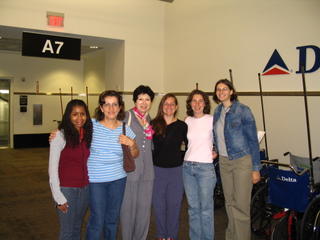
From Logan Airport (Gate A7) to Durban, South Africa (outside)


Sawubona from South Africa!

Yesterday we had our first South African healthcare experience in Durban. It was eye-opening to say the least. We spent the day working with the nurses from a non-governmental organization called Highway Hospice; Janet, Zee, and Mandla. They were amazing people who took us out into the community to make house calls with them. We all saw different neighborhoods and had different experiences, but in the end each had very special experiences. Meghan and I went out with Zee into Chesterville and Mayorville where we met with three patients all of whom were very sick and dying of either AIDS or cancer. For me it was very emotional....especially when we went to the house of a 27-year-old woman with end-stage AIDS who was emaciated and so sick that she could hardly move. We sat with her and her two cousins while Zee examined her and we held her 10-month-old baby girl. It was devastating to acknowledge her imminent death while embracing the vibrant child who will inevitably become an orphan. It was unbelievable to see how little people have but how they adapt to such limited conditions. The extent of what they need is overwhelming! The Hospice gave us a list of things they could use to give to their patients. Some of those things I will list here and if you want to send something or make a donation to an organization that is doing great things....please do so!

Children's Clothing:
Baby to 16 years old, boys and girls
Children's shoes 0-16 years old boys and girls

Toys:
Jigsaw Puzzles
Crayons
Coloring books
Building blocks
Dolls
Soccer Balls
Cuddley Toys
Children's Books/simple with lots of pictures

Any toys....especially educational!

Please mail toys or clothing to the following address:

Highway Hospice
PO Box 28
Westville 3630
South Africa

Also check out their website and make a donation at www.hospice.co.za

We'll send you more updates on our journey and what we are seeing.......thanks for reading.

Lisa

Thursday, July 14, 2005

We're here

We're here in Durban after 29 hours of travelling. We got settled and took a walk around our environs. Costa and Jenny had us to dinner along with some other colleagues from the States. It was a lovely evening. We go to a hospice tomorrow AM. Time to sign off and get some real sleep. All the Best from all of us. INGE